
Introduction
Gomutra, also commonly written as Komutra, is the traditional Sanskrit-derived term for cow urine. Within certain Hindu traditions, gomutra has been associated with sacredness, ritual purification, traditional practices and the broader spiritual importance of the cow.
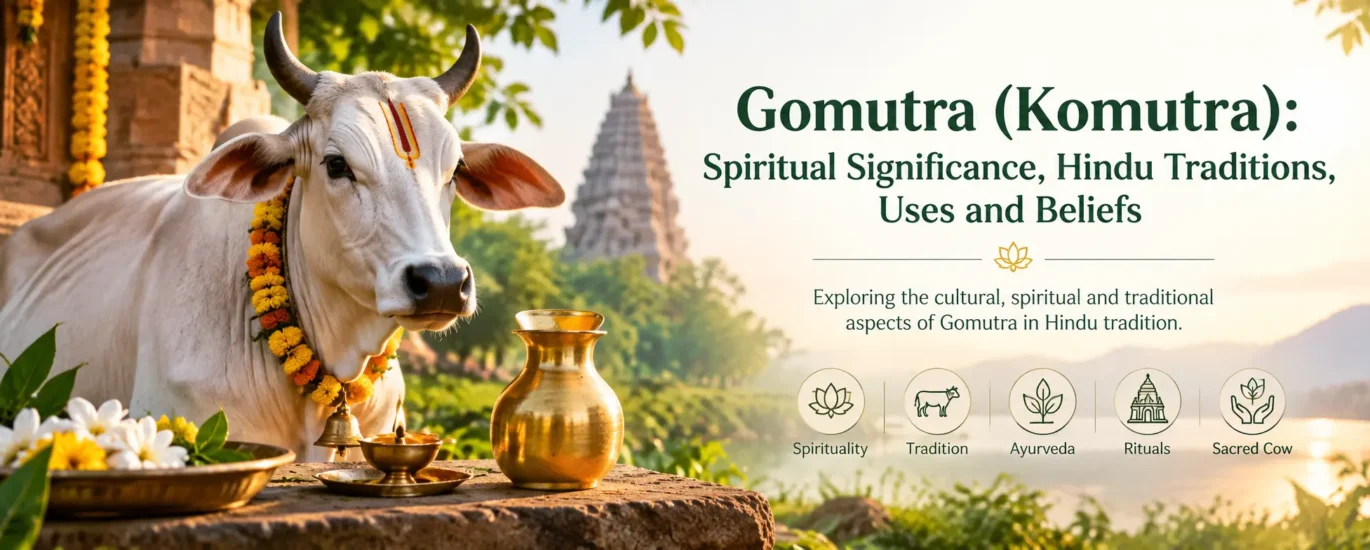
The cow has held an important place in Indian civilization for centuries. In many Hindu traditions, the cow is revered as Gau Mata, or the mother cow, and is associated with nourishment, abundance, compassion, agriculture and sacred living. Because of this cultural and religious relationship with the cow, different substances obtained from the cow have acquired traditional significance.
Gomutra is particularly interesting because it sits at the intersection of Hindu spirituality, ritual traditions, Ayurveda, rural Indian culture, agriculture and traditional knowledge.
At the same time, it is important to distinguish spiritual beliefs and traditional practices from modern medical evidence. Traditional descriptions of gomutra should not automatically be interpreted as proof that it can prevent or cure diseases.
This article explores the meaning of gomutra, its spiritual significance, its connection with Panchagavya, traditional Hindu practices, Ayurveda, agriculture and the questions surrounding its modern use.
What Is Gomutra?
The word gomutra comes from Sanskrit. Go refers to the cow, while mutra refers to urine. Therefore, gomutra literally means cow urine.
In traditional Indian culture, gomutra has been discussed alongside other cow-derived substances, particularly in connection with religious customs and traditional practices.
Its significance can be understood through several different perspectives:
- Hindu religious traditions
- Ritual purification
- Panchagavya
- Ayurveda
- Traditional Indian agriculture
- Rural culture
- Spiritual practices
- Traditional knowledge
The importance attached to gomutra varies among communities. Hinduism includes many regional, philosophical and ritual traditions, so practices associated with gomutra should not be assumed to be universal.
Why Is the Cow Sacred in Hindu Tradition?
Understanding gomutra requires first understanding the cultural significance of the cow.
For many Hindus, the cow represents nourishment, generosity, motherhood and abundance. Traditionally, cattle were also central to agricultural communities because they provided milk, manure and other resources.
The cow became associated with the idea of giving and sustaining life.
This broader cultural relationship helped create the concept of Gau Mata, in which the cow is regarded with reverence and treated as a symbol of maternal care.
Cow-derived substances consequently became associated with different aspects of traditional Indian life.
Milk, curd and ghee have important roles in food and religious offerings, while cow dung has historically been used in rural homes and agriculture.
Gomutra also developed a place within certain traditional practices.
Spiritual Significance of Gomutra
In some Hindu traditions, gomutra is associated with purification.
Purification has a deeper meaning in Indian spiritual thought than simply physical cleanliness. It can refer to preparing oneself, a space or an object for religious activity.
Traditional concepts of purification may involve:
- Water
- Mantras
- Incense
- Sacred ash
- Sandalwood
- Flowers
- Fire
- Cow-derived substances
Gomutra may appear in some traditional purification-related practices because of its association with the sacred cow.
This spiritual meaning should be understood within its religious context. Ritual purification and modern concepts such as medical sterilization are not the same thing.
Gomutra and Panchagavya
One of the most important traditional concepts associated with gomutra is Panchagavya.
The word Pancha means five, while Gavya refers to substances obtained from the cow.
Panchagavya traditionally consists of:
- Milk
- Curd
- Ghee
- Gomutra
- Cow dung
Panchagavya has appeared in traditional religious and cultural contexts, including discussions of ritual purification and traditional practices.
The exact preparation and use may differ according to region, tradition and purpose.
For someone studying Indian spirituality, Panchagavya provides an interesting example of how religion, agriculture, cattle care and traditional knowledge became interconnected.
Gomutra in Hindu Ritual Traditions
Gomutra has been associated with purification practices in certain Hindu traditions.
Traditional rituals can vary significantly between regions and communities. Therefore, there is no single gomutra ritual that can be described as universally followed by all Hindus.
Depending on the tradition, cow-derived substances may be connected with:
Ritual purification
Certain traditional practices incorporate cow-derived substances when preparing a person, object or environment for a religious activity.
Sacred spaces
In some traditional settings, cow-derived materials have been associated with maintaining or preparing spaces considered spiritually important.
Ceremonial practices
Some religious traditions include cow-derived substances as part of particular ceremonies or purification procedures.
Traditional household customs
Historically, cattle were part of everyday rural life, meaning that religious and practical uses of cow-derived materials often existed side by side.
The significance of these practices comes from their cultural and religious context.
Gomutra and Ayurveda
Gomutra is also discussed in relation to Ayurveda, India’s traditional system of medicine.
Historical Ayurvedic traditions include numerous plant, mineral and animal-derived substances. Gomutra appears in some traditional discussions and preparations.
However, it is important to make a distinction between:
Traditional Ayurvedic knowledge — what traditional texts and practitioners describe.
and
Modern clinical evidence — what appropriately designed scientific studies demonstrate regarding safety and effectiveness.
A traditional reference does not automatically establish a substance as a scientifically proven treatment.
This distinction becomes especially important when gomutra is discussed in relation to serious illnesses.
Traditional Claims About Gomutra
Various traditional and contemporary sources attribute different properties to gomutra.
Claims may associate it with:
- Purification
- Traditional wellness
- Spiritual cleansing
- Digestive health
- Immunity
- Detoxification
- Traditional medicinal preparations
- Agricultural applications
These claims do not all have the same historical or scientific basis.
A responsible discussion should therefore distinguish between traditional belief, preliminary research and established medical evidence.
For a spiritual audience, gomutra can be explored respectfully as part of Indian cultural heritage without presenting every traditional claim as a medically proven fact.
Does Gomutra Cure Diseases?
This is one of the most important questions surrounding gomutra today.
There are claims online that gomutra can cure or prevent various diseases, including serious conditions.
Such claims should be treated cautiously.
There is not sufficient high-quality clinical evidence to establish gomutra as a cure for serious diseases such as cancer, diabetes or infections.
Gomutra should therefore not be used as a substitute for medical diagnosis or evidence-based treatment.
Anyone with a medical condition should consult a qualified healthcare professional and should not stop prescribed medication or treatment because of claims about traditional remedies.
This distinction does not prevent people from studying the cultural or spiritual importance of gomutra. It simply keeps religious tradition and medical evidence in their appropriate contexts.
Gomutra and Modern Scientific Research
Modern scientific research has examined cow urine and various cow-derived preparations.
Laboratory studies may investigate chemical components or biological properties. Such research can provide useful information and may lead to further scientific questions.
However, a laboratory observation is not the same as demonstrating that a substance is an effective treatment for people.
Medical evidence generally requires appropriately designed human research examining:
- Safety
- Dosage
- Effectiveness
- Side effects
- Interactions
- Long-term outcomes
Therefore, claims about gomutra’s medicinal effects should be evaluated according to the quality of the evidence supporting them.
This approach allows traditional knowledge to be studied without confusing preliminary findings with established medical treatment.
Gomutra and Spiritual Wellness
Spirituality is broader than medicine.
For many people, spiritual wellness involves:
- Prayer
- Meditation
- Devotion
- Self-discipline
- Compassion
- Gratitude
- Service
- Respect for nature
- Ethical living
Within this broader framework, gomutra may have symbolic importance because of its relationship with the sacred cow.
The spiritual value attributed to a traditional practice can therefore be understood independently from claims about treating disease.
A person may study gomutra because of an interest in Hindu traditions, Indian history or spiritual customs without necessarily treating it as a medical substance.
Gomutra and the Concept of Purity
Purity is an important theme across many Indian spiritual traditions.
Purity may refer to:
- Purity of thought
- Purity of intention
- Purity of surroundings
- Ritual preparation
- Personal discipline
- Devotion
Traditional purification practices often combine physical actions with prayer, mantra and intention.
Within some traditions, gomutra is associated with this broader concept of purification.
It is therefore useful to understand the word purification in its cultural and ritual sense rather than automatically equating it with modern scientific disinfection.
Gomutra and Rural Indian Culture
The history of gomutra is closely connected with the historical importance of cattle in Indian villages.
For traditional agricultural communities, cattle were valuable resources.
They provided:
- Milk
- Curd
- Ghee
- Manure
- Agricultural support
- Household resources
Cattle were therefore part of both economic and cultural life.
The relationship between agriculture, cattle and religious tradition helps explain why cow-derived products acquired significance beyond their practical uses.
Gomutra can be viewed within this larger historical relationship rather than as an isolated substance.
Gomutra and Traditional Agriculture
Cow urine has also been used in some traditional agricultural practices.
Certain natural farming systems incorporate cow urine into preparations intended for agricultural use.
Traditional agricultural knowledge often emphasizes locally available resources and recycling organic materials.
However, the effectiveness of any agricultural preparation depends on factors such as:
- Crop
- Soil
- Concentration
- Preparation method
- Application method
- Climate
- Farming conditions
Therefore, traditional agricultural claims should be assessed based on the specific practice rather than generalized into universal claims.
Gomutra and Environmental Traditions
Traditional Indian village life often relied heavily on renewable local resources.
Cow dung and other cattle-derived materials were historically incorporated into agriculture and household practices.
This has contributed to modern interest in traditional and natural farming.
The environmental value of any practice, however, should be evaluated according to measurable factors such as soil health, resource use, crop productivity and environmental impact.
Traditional knowledge and modern agricultural science can complement each other when practices are studied carefully.
Gomutra and Spiritual Products
Spiritual practice often involves objects that help create a devotional environment.
These may include:
- Rudraksha malas
- Yantras
- Pooja idols
- Diyas
- Sacred ornaments
- Prayer malas
- Traditional devotional items
Gomutra belongs to a different category because it is traditionally associated with a substance rather than a spiritual product.
Nevertheless, both subjects share a common theme: the role of ritual, intention and sacred symbolism in spiritual practice.
For devotees, the preparation of a spiritual space can involve cleanliness, prayer, mantra, incense and respectful placement of sacred objects.
Gomutra and Personal Spiritual Practice
People interested in traditional Hindu spirituality may explore gomutra as part of their study of Indian culture.
Spiritual practice can include:
- Learning about Hindu traditions
- Studying Sanskrit terminology
- Understanding Panchagavya
- Visiting temples
- Caring for cows ethically
- Supporting traditional gaushalas
- Practising meditation
- Reciting mantras
- Maintaining a home prayer space
- Studying traditional texts
The deeper spiritual principle is not necessarily the substance itself but the values associated with devotion, reverence, compassion and disciplined living.
Is Gomutra Used by All Hindus?
No.
Hinduism is diverse, and practices differ across regions, communities and philosophical traditions.
Some people may regard gomutra as spiritually significant, while others may not use it.
Likewise, the practice of Panchagavya and other cow-derived traditions varies.
It is therefore more accurate to say that gomutra has traditional significance in certain Hindu practices rather than claiming that every Hindu follows the same customs.
Important Safety Considerations
Anyone considering the physical use or consumption of animal-derived substances should exercise caution.
Potential concerns can include:
- Microbial contamination
- Contamination during collection or storage
- Unknown composition
- Possible adverse reactions
- Interactions with medicines
- Lack of adequate clinical evidence for claimed medical benefits
Traditional spiritual use should not replace medical treatment.
People who are pregnant, elderly, very young, immunocompromised or living with a medical condition should seek appropriate professional advice before consuming unconventional substances.
Tradition and Science Can Be Studied Together
A balanced understanding of gomutra does not require rejecting either tradition or science.
Traditional knowledge can be studied as:
- Cultural heritage
- Religious history
- Ethnographic knowledge
- Agricultural knowledge
- Traditional medicine
Science can investigate specific claims through:
- Laboratory studies
- Toxicology
- Controlled experiments
- Human clinical studies
- Epidemiological research
These approaches answer different questions.
Spiritual tradition asks:
What does gomutra mean within a particular religious or cultural tradition?
Scientific research asks:
What measurable effects does gomutra have, and are those effects safe and reproducible?
Keeping these questions separate creates a more respectful and informative understanding.
Gomutra and the Deeper Meaning of Gau Mata
The spiritual importance of gomutra ultimately connects back to the broader idea of Gau Mata.
For many Hindus, the cow represents:
Nourishment — through milk and dairy products.
Abundance — through its historical importance to agricultural communities.
Motherhood — reflected in the traditional expression Gau Mata.
Compassion — through the cultural emphasis on caring for living beings.
Nature — through the relationship between cattle, agriculture and the land.
Sacredness — through the cow’s place in Hindu religious culture.
Understanding this symbolism provides a richer perspective on why cow-derived substances have appeared in traditional Indian practices.
Frequently Asked Questions About Gomutra
What is gomutra?
Gomutra is the Sanskrit-derived term for cow urine. It has traditional cultural and religious associations in some Hindu traditions.
What does gomutra mean spiritually?
In certain Hindu traditions, gomutra is associated with purification and the sacred status of the cow. Its spiritual meaning comes from the broader cultural reverence for Gau Mata.
Why is the cow considered sacred in Hinduism?
The cow has historically been associated with nourishment, motherhood, abundance, agriculture and compassion. The degree and form of reverence vary among Hindu traditions.
What is Panchagavya?
Panchagavya traditionally refers to five substances obtained from the cow: milk, curd, ghee, gomutra and cow dung.
Is gomutra used in Hindu rituals?
Some Hindu traditions associate gomutra and other cow-derived substances with purification or ceremonial practices. These customs are not universal.
Is gomutra part of Ayurveda?
Gomutra appears in some traditional Ayurvedic discussions and preparations. Traditional references should not automatically be interpreted as proof of modern clinical effectiveness.
Can gomutra cure cancer?
There is insufficient clinical evidence to establish gomutra as a cure for cancer. It should not replace evidence-based cancer diagnosis or treatment.
Is gomutra used in agriculture?
Cow urine is used in some traditional and natural farming practices. The effectiveness of individual preparations depends on how they are prepared and applied.
Do all Hindus use gomutra?
No. Hindu practices vary considerably by community, region and tradition.
Is gomutra the same as Panchagavya?
No. Gomutra means cow urine, while Panchagavya is a traditional combination of five cow-derived substances, one of which is gomutra.
What is the spiritual importance of Gau Mata?
Gau Mata, meaning mother cow, represents the traditional reverence for the cow in many Hindu communities and is associated with nourishment, abundance and compassion.
Conclusion
Gomutra, or Komutra, is more than a subject of modern debate. It is connected to a much larger cultural story involving the sacred cow, Hindu spirituality, Panchagavya, Ayurveda, agriculture, ritual purification and traditional Indian life.
For people interested in spirituality, gomutra offers an opportunity to understand how ancient Indian communities connected religious belief with nature, agriculture and everyday life.
Its traditional spiritual significance should be respected within its cultural context, while claims about medical benefits should be evaluated according to appropriate scientific evidence.
A balanced approach allows us to appreciate India’s traditional knowledge without confusing spiritual belief with scientifically established medical treatment.
For today’s spiritual seeker, the deeper lesson may lie not only in studying individual substances, but also in understanding the values surrounding them: reverence for life, gratitude, compassion, devotion, respect for nature and responsible living.
Gomutra therefore remains an important subject for anyone exploring the relationship between Hindu tradition, Indian cultural heritage and spiritual practice.
